
Trafalgar Square
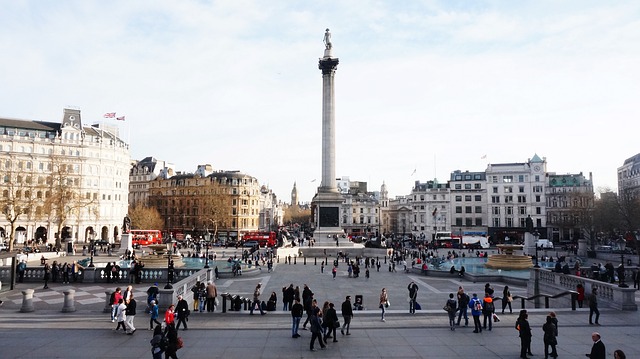
The square is considered the heart of the British capital and hosts events, concerts and celebrations, including Chinese New Year, St. Patrick’s Day, St. George’s Day (patron saint of England) and the Gay Pride Parade.
Trafalgar Square is also the centre of British democracy, as it is where the most varied protests and demonstrations take place.
In December, the square receives a beautiful Christmas tree directly from Norway and there are daily performances of choirs singing traditional Christmas carols.
History of Trafalgar Square
Used for several centuries as the stable courtyard of Whitehall Palace, the area was transformed in the early 1800s into a public space adjacent to the then new avenue linking Charing Cross to Portland Place. In 1830 the square was officially named Trafalgar Square, in honour of the Battle of Trafalgar, in which the British naval fleet, commanded by Admiral Nelson, won against the fleets of France and Spain in one of the Napoleonic Wars. Trafalgar Square underwent major renovations in 2003, which expanded the pedestrian area to include the central staircase connecting the square to the National Gallery, located at the northern end. Elevators, public washrooms and a café, the Cafe on the Square, were also installed.
What to see in Trafalgar Square
Nelson Column
The Nelson Column, one of the symbols of London, is a column that houses the granite statue of Admiral Nelson, supported by a bronze base. The column is 52 metres high and the statue is 5 metres high.
It was installed on the square in 1843, a few years before the two fountains designed by John Barry, the architect who designed the magnificent Palace of Westminster.
Mermaids, dolphins and tritons (a Greek god represented with the body of man and the tail of a fish) adorn the fountains. The bronze lions that guard the base of Nelson’s column were not added to the square until 1867, almost 25 years after Nelson’s column.
Getting to Trafalgar Square
The Charing Cross metro station (Bakerloo and Northern lines) has an entrance/exit on the square, near Nelson’s Column. Other stations nearby :
Leicester Square (Northern and Piccadilly lines)
Piccadilly Circus (Bakerloo and Piccadilly lines)
Backfill (Bakerloo, Northern, District and Circle lines)
Several bus routes pass through Trafalgar Square, including routes 6, 9, 11, 12, 13, 15, 23, 24, 29, 53, 87, 88, 91, 139, 159, 176 and 453.
https://goo.gl/maps/aJanBBqTt1tMXEvX8


